
close
Choose Your Site
Global
Social Media
Views: 0 Author: Site Editor Publish Time: 2026-05-28 Origin: Site


Replacing a failing fluid power unit on heavy machinery represents a high-stakes capital decision. An unexpected breakdown stops your job site completely. Mismatched replacements lead to sluggish cycle times, severe system overheating, or catastrophic cross-contamination. Meanwhile, excessive OEM lead times force expensive operational downtime upon your business. The primary goal is securing a reliable replacement. You need a unit perfectly matching original flow rates and pressure ratings. It must fit the exact machine flange and spline architecture. Finally, it should align perfectly against budget and timeline constraints without sacrificing system integrity. This guide explains how to properly identify, select, and install the right replacement. You will learn how to decode machine specifications accurately. We also explore the realities of OEM versus aftermarket options. By the end, you can confidently source a robust hydraulic pump for excavator system to keep your fleet moving.
Tonnage dictates technology: 1–10 ton mini-excavators typically rely on specific piston or gear configurations (e.g., KAYABA), while 10+ ton machines require high-pressure axial piston models (e.g., KAWASAKI).
Safety margins matter: Industrial standards dictate a safety margin of 3 to 4 times the baseline operating pressure to handle extreme digging loads.
The OEM vs. Aftermarket delta: Verified Tier-1 aftermarket pumps offer 30–50% cost reductions and immediate availability compared to 4–12 week OEM lead times, provided they meet ISO and torque specifications.
Preventative baseline: 90% of premature pump failures stem from fluid contamination or incorrect viscosity (e.g., misapplying ISO VG 46 in extreme cold) rather than mechanical defect.
Modern heavy excavators demand immense power. They require variable displacement axial piston pumps to function efficiently. Engineers mandate these swashplate designs because they dynamically adjust fluid flow based on immediate load requirements. As the operator demands more force, the internal swashplate angle changes. This action increases displacement seamlessly.
These robust units handle extreme operational capabilities. They easily sustain high-pressure thresholds during continuous digging operations. A standard unit maintains a rated pressure around 34.3 MPa. During intense breakout tasks, peak pressures often surge to 39.2 MPa. Furthermore, these sophisticated designs support complex multi-function tasks. They utilize Pressure and Flow Regulation (DFR/DFLR control) to balance the boom, arm, and bucket simultaneously without stalling the diesel engine.
Gear models operate differently from piston models. They function as fixed-displacement solutions. Every rotation delivers an exact, unvarying volume of fluid. Manufacturers primarily use them for pilot circuits on larger machines. In these setups, they supply the low-pressure fluid necessary to shift heavy spools inside the main control valves. However, on micro-excavators, these units often drive the entire main system due to their simplicity and low cost.
Conversely, vane pumps rarely appear in modern heavy digging equipment. They suffer from inherent pressure limitations. While they operate quietly, they cannot survive the brutal shock loads generated by rock breaking. You will typically only encounter vane technology in legacy machinery or stationary industrial applications.
Buyers must verify their specific machine architecture before ordering replacements. Most excavators utilize open-loop systems. In this design, fluid travels from the reservoir, moves through the actuators, and dumps back into the reservoir. This constant circulation acts as a highly cost-effective, tank-cooled mechanism. It dissipates heat efficiently across large fluid volumes.
Closed-loop systems operate differently. They send exhaust fluid directly back into the pump inlet instead of the main tank. This creates a compact, highly responsive circuit. However, it requires stricter fluid temperature management. You must rely on dedicated charge pumps and integrated heat exchangers to prevent the fluid from degrading under thermal stress.
Displacement directly dictates actuator speed. It measures the volume of fluid moved per single shaft revolution. Larger displacements push more fluid, translating into faster boom and arm movements. Industry benchmarks vary significantly by machine size. Large excavators often require massive outputs reaching up to 150 Gallons Per Minute (GPM). Mid-sized digging machines typically hover around 234 Liters per minute (L/min). You must match the original displacement precisely. An undersized unit will cripple the machine cycle times.
System force relies entirely on pressure. You must match the peak operating pressure of the original component. Standard digging operations routinely push systems up to 4,500 PSI (approximately 31 MPa). If a replacement cannot safely sustain this threshold, internal components will fail rapidly. The housing could crack under the stress. Always cross-reference the manufacturer data plate to confirm the necessary MPa ratings.
Operating environments expose heavy equipment to violent physical shocks. Pulling stubborn stumps or breaking dense rock sends massive pressure spikes back through the hydraulic lines. Therefore, you must verify rigorous engineering safety margins. Advise your procurement team to ensure the replacement unit possesses a verified safety factor. It should handle 3x to 4x the continuous load rating. This robust bursting margin guarantees survival during unexpected operational shock loads.
Performance numbers mean nothing if the physical installation fails. You must verify exact OEM part numbers before purchasing. First, determine the rotational direction. You must know if the shaft spins clockwise (R) or counter-clockwise (L) when viewed from the driven end. Installing the wrong rotation destroys the unit instantly upon engine startup. Next, carefully measure the mounting flange dimensions. Count the drive spline teeth. Verify the distance between bolt holes to ensure a seamless drop-in fit.
Specification Parameter | Heavy Excavator (20+ Ton) | Mini Excavator (1-10 Ton) | Critical Matching Rule |
|---|---|---|---|
Average Flow Rate | 150 GPM / 560 L/min | 15-30 GPM / 55-115 L/min | Match exact OEM displacement limits. |
Peak Pressure | 34.3 - 39.2 MPa | 20.6 - 24.5 MPa | Ensure 3x safety burst margin. |
Shaft Rotation | Usually Dual/Tandem Setup | Clockwise (R) or Counter (L) | Verify direction before installation. |
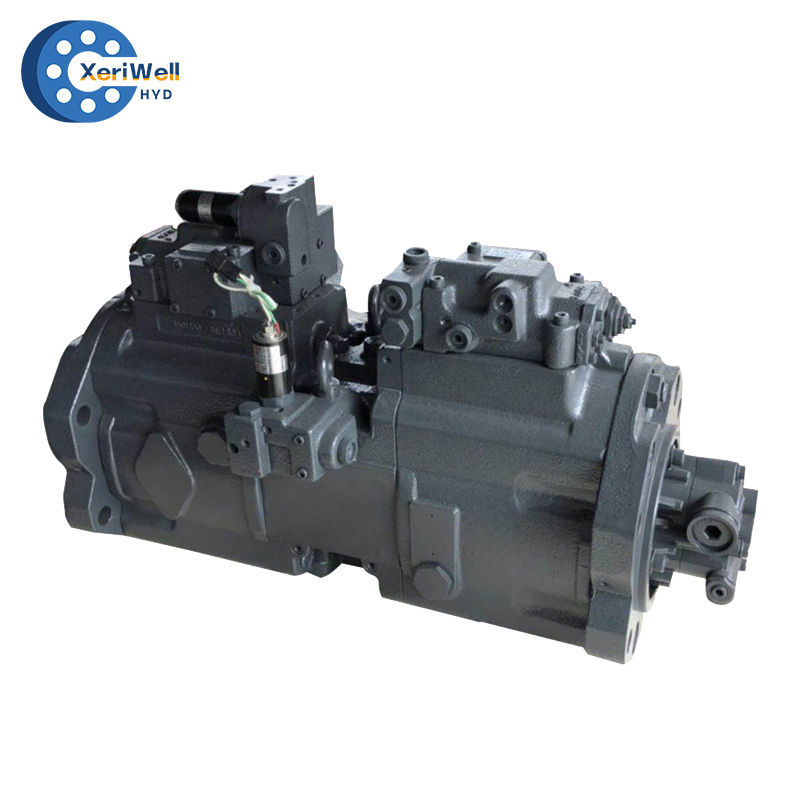
Kawasaki engineering dominates the heavy machinery landscape. Most prominent manufacturers rely heavily on the renowned K3V and K5V series. These units offer massive displacement ranges spanning from 63cc to 280cc. They feature tandem configurations delivering exceptional digging power. If you operate a heavy rig, you likely need a KAWASAKI Hydraulic Pump replacement. Buyers must understand series interoperability. Upgrading from a K3V to a K5V often improves power density. However, this upgrade path requires verifying electronic regulator compatibility and physical footprint constraints inside the engine bay.
Compact equipment faces unique spatial challenges. Mini-excavators ranging from 1 to 10 tons require dense, space-saving power units. The industry standard for these machines remains the PSVD series. A genuine or equivalent KAYABA Hydraulic Pump provides exceptional dual-pump performance housed within a single compact casting. This clever architecture runs both the main digging circuits and the independent swing motor circuit efficiently. Sourcing these specific configurations ensures your mini-excavator regains its factory-level agility.
Some major equipment manufacturers utilize heavily modified proprietary architectures. They tweak standard pump designs to integrate deeply into their specific machine computer systems. Finding a compatible HITACHI Hydraulic Pump requires checking the specific HPV series regulators. These regulators communicate directly with the machine ECU.
Similarly, a KOMATSU Hydraulic Pump often features unique electronic spool controls. You must cross-reference exact OEM part numbers, such as the famous Komatsu 708-series codes. Failing to match these exact proprietary control interfaces results in error codes. The machine will default into safe mode, refusing to dig at full capacity.
Procurement teams constantly battle OEM lead times. Ordering directly through the original manufacturer carries a steep financial premium. Furthermore, global supply chain delays routinely push OEM deliveries out 4 to 12 weeks. This waiting period paralyzes construction schedules. In contrast, verified Tier-1 aftermarket equivalents provide immediate availability. Warehouses stock these replacements ready to ship globally. More importantly, they deliver aggressive 30–50% cost savings upfront. This financial advantage allows businesses to reallocate capital toward preventative maintenance elsewhere.
You cannot blindly trust every aftermarket supplier. Buyers must implement a strict vetting process to separate premium manufacturers from low-tier producers. Demand concrete proof of quality control. Ensure the supplier follows strict ISO cleanliness standards, specifically NAS 9 or better. Contaminated assemblies destroy systems on day one. Next, verify strict SAE flange dimensional compliance. Finally, check that the manufacturer assembles their units using VDI 2230 installation torque specifications. These documented standards guarantee the replacement equals the original factory durability.
Comparison Factor | OEM Supply | Verified Tier-1 Aftermarket |
|---|---|---|
Cost Premium | Highest (Dealer Markups) | 30% - 50% Savings |
Lead Times | 4 to 12 Weeks (Average) | Immediate / Next Day Shipping |
Standards Compliance | Guaranteed Exact Specs | Vetted strictly via ISO/SAE docs |
Original equipment manufacturers typically provide comprehensive coverage. However, dealing with their warranty claims often involves intense dealer scrutiny. When choosing aftermarket routes, you must find suppliers offering transparent, straightforward replacement warranties. Furthermore, assess their lifecycle support. A credible supplier stocks readily available rebuild kits, replacement rotating groups, and complete seal kits. This availability ensures you can service the unit cheaply five years down the road.
You must actively avoid aggressively cheap, unbranded alternatives. These heavily discounted clones flood online marketplaces. They lack proper metallurgical treatments on internal components. The plungers and brass cylinder blocks wear down rapidly under heat. This poor metallurgy inevitably leads to early shaft seal failures. Worse, the internal rotating groups can shatter catastrophically. When a clone shatters, it sends metal shrapnel throughout the entire machine architecture. This ruins the control valves and drive motors, costing tens of thousands in secondary repairs.
Installation success depends heavily on fluid management. You must mandate matching the fluid viscosity to your local climate. Operating temperatures drastically alter fluid thickness. For temperate environments, industry experts universally recommend ISO VG 46 anti-wear fluid. If you operate in sweltering, hot environments, upgrade to a thicker ISO VG 68. Conversely, freezing environments demand a thinner ISO VG 15 or 32. Misapplying thick VG 46 in extreme winter cold starves the suction lines. This starvation destroys a brand-new installation within hours.
Never install a pristine replacement into a dirty circuit. You must specify rigorous filtration upgrades upon installation. Drain the reservoir completely and flush the lines. Install fresh 80–150 mesh suction strainers inside the main tank. These strainers catch large debris before it enters the suction port. Additionally, upgrade your return filters to strict 10-micron absolute standards. Superior filtration acts as the ultimate insurance policy for your new capital investment.
Setting realistic maintenance expectations prevents sudden breakdowns. Establish a rigid inspection schedule revolving around the 2,000-hour operational mark. At this interval, mechanics should inspect the main FKM (Viton) shaft seals for hardening or weeping. Thermal cycling naturally degrades these elastomers over time. Furthermore, mandate cleaning or replacing the internal suction strainers at this exact benchmark. Proactive 2,000-hour interventions add years to the component lifespan.
Operators represent the first line of defense. Teach buyers and operators to distinguish between normal wear and fatal conditions. General wear manifests as a gradual, sluggish response. The boom simply moves slower over months. Fatal cavitation, however, presents distinct auditory warnings. It sounds like marbles rattling inside the casing. This whining noise indicates severe aeration due to restricted suction. Recognizing these sounds early enables proactive parts ordering before the system suffers total mechanical failure.
Successfully navigating excavator pump replacement boils down to precise matching and proactive maintenance. A rushed decision risks severe secondary damages, while careful selection ensures years of profitable machine operation. Use this systematic approach to finalize your purchasing strategy.
Evaluation Checklist:
Extract the exact OEM code and physical machine weight from the data plate.
Determine whether your specific system requires a variable piston or fixed gear unit.
Verify pressure and flow ratings against the manufacturer spec sheet.
Weigh the financial impact of OEM lead times against verified, in-stock aftermarket availability.
Call to Action: Do not let equipment downtime ruin your project margins. Consult with a fluid power specialist today. Request a detailed quote using your specific excavator model, serial number, and exact OEM part code.
A: Rarely feasible without major hydraulic and electronic control system overhauls; stick to OEM specs.
A: Depends heavily on flange design, regulator type, and ECU mapping; verify with the supplier.
A: You should test the pump outlet pressure using inline hydraulic gauges. Connect the gauges directly to the designated test ports. If the pressure readings hit OEM targets smoothly, the unit functions correctly. In this scenario, the control valve likely causes the sluggish response.
A: Yes, using rotary group repair kits—plungers, shoes, valve plates—if the main housing is un-scored, but weigh labor downtime vs. a drop-in replacement.


